The frontier AI challenge is not intelligence. It's reproducibility.
As intelligence becomes a commodity, reliability becomes the constraint.
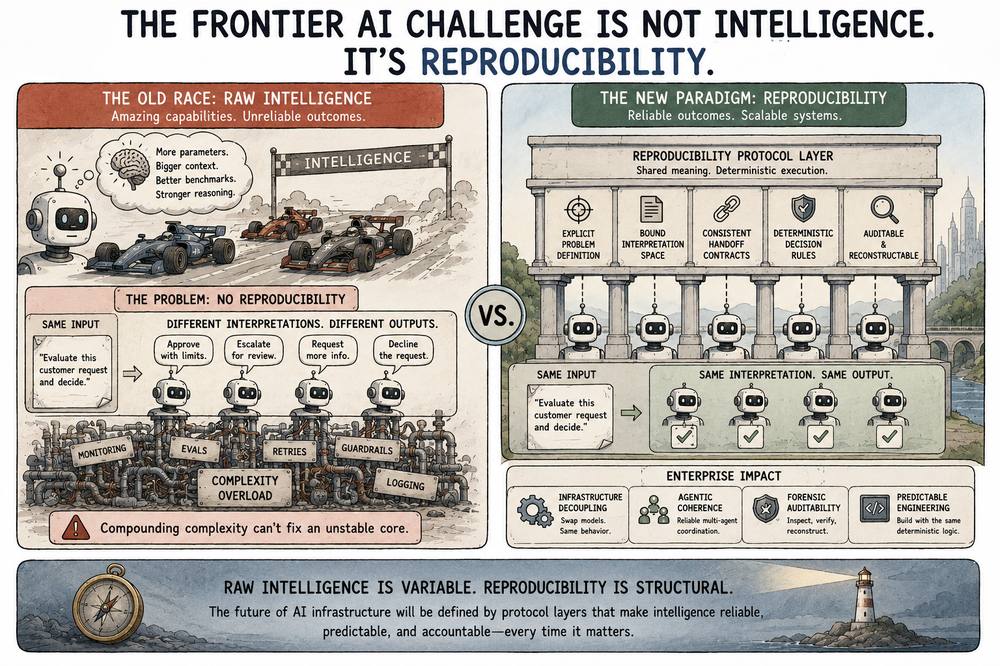
For the past several years, the AI industry has been locked in a race for raw intelligence. Every major milestone has been measured by expanded capability: higher parameter counts, optimized benchmarks, longer context windows, and superior performance on complex reasoning tasks. This race has produced undeniable results, yielding systems that can seamlessly write software, synthesize dense research papers, and analyze intricate financial statements. Yet as advanced intelligence becomes an abundant commodity, a more profound limitation has emerged. Enterprises are no longer questioning whether an AI can generate an answer; they are questioning whether they can rely on it.
This distinction changes the entire architectural paradigm. The critical infrastructure upon which modern civilization depends does not rely on intelligence or creativity. When capital moves between global banking institutions, no one evaluates the intellect of the network. When an aircraft communicates with air traffic control, the protocol isn't celebrated for its nuance. Secure web connections succeed precisely because they are static, predictable, and blind to context. These systems scaled because they guarantee that an identical request yields an identical outcome today, tomorrow, and across any routing infrastructure. Reliability, not cognitive capability, is the prerequisite for systemic scale.
Historically, engineering challenges of this nature are solved through protocols rather than individual component optimization. The internet itself is the clearest precedent. The early physical networks were fundamentally unstable, packets were routinely lost, connections dropped, and hardware failed. Rather than attempting to build flawless physical infrastructure, systems engineers introduced an abstract protocol layer designed to guarantee reliable communication over unreliable components. TCP/IP became one of the most successful architectural triumphs in history by transforming unpredictable networks into dependable utilities.
Today, generative AI faces an identical structural crisis. The underlying models are probabilistic by design. Different models produce divergent outputs, and a single model can fluctuate across separate runs. When multi-agent systems are introduced, this volatility compounds across every layer of interpretation and coordination.
The industry's current reflex is to battle this instability with compounding complexity. Teams are wrapping pipelines in dense observation layers, continuous evaluation frameworks, infinite retry loops, and cascading agent-on-agent supervision. While these tactics mitigate symptoms, they ultimately amount to building complex containment structures around an unstable core rather than addressing the source of the volatility itself.
What if engineering reliable AI systems requires protocol layers in the exact same way internet plumbing did? What if reproducibility is not a model-training problem, but a distributed coordination problem?
This perspective shifts the focus from model intelligence to the governance of interpretation. Before any autonomous system can execute a decision, it must define the precise parameters of the problem it is solving. If an instruction permits multiple valid logical readings, multiple outcomes remain structurally possible. Increasing a model's intelligence might make its chosen path sound more articulate, but it does nothing to eliminate the baseline ambiguity of the task.
True reproducibility is not merely about forcing an LLM to output the same string twice. It is about establishing explicit protocol conditions under which entirely independent systems deterministically converge on the same decision because they are bound to the exact same declared meaning.
When reproducibility becomes an invariant property of a protocol rather than a variable property of a model, the enterprise landscape shifts:
- Infrastructure Decoupling. Organizations can swap underlying model providers instantly without shifting systemic behavior.
- Agentic Coherence. Multi-agent workflows can seamlessly coordinate and pass handoffs against strict, shared runtime requirements.
- Forensic Auditability. Regulatory and internal compliance teams gain the ability to inspect, verify, and mathematically reconstruct decisions after the fact.
- Predictable Engineering. Developers can reason about AI agent behavior using the same deterministic logic applied to traditional software code.
Most importantly, this approach ensures that operational responsibility remains permanently visible. The dominant narrative assumes that general intelligence is the ultimate destination for AI. History suggests otherwise. Raw capability rarely transforms civilization on its own; standardizing protocols do. Electricity only revolutionized industry when grid standards emerged; global commerce only scaled when shipping container dimensions and trade protocols were codified.
The most disruptive shift of the coming decade will not be a frontier model with twice the reasoning capacity of its predecessor. It will be the protocol layers that allow that intelligence to operate safely, predictably, and accountably within human infrastructure.
The future will bring more intelligent models, but turning those models into dependable utility infrastructure requires something far less glamorous: the absolute certainty of the same governed decision, for the same exact reason, every single time it matters.