Why "Just Code It" Fails in the Age of AI Agents
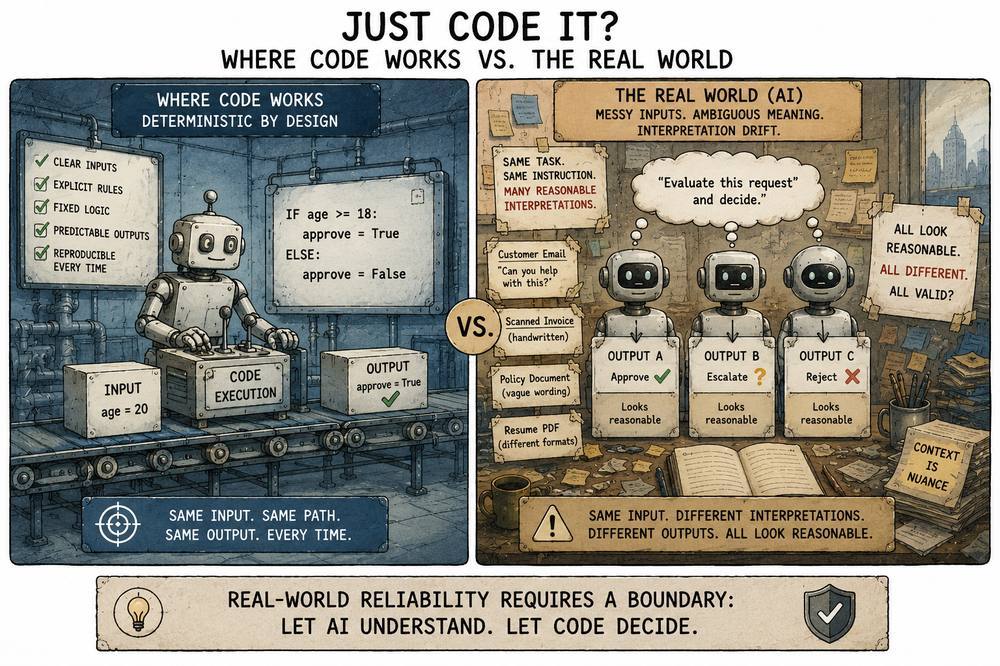
You can hard-code rules. You cannot hard-code the real world.
One of the most persistent objections to AI reliability frameworks is also, on its surface, one of the most logical: "If a decision must be deterministic, why use an LLM at all? Just write code."
Anyone engineering production systems has encountered this perspective, and in many scenarios, it is entirely correct. If a problem space is fully specified, the inputs cleanly structured, and the operational rules immutable, traditional software remains the most efficient solution ever devised. A payroll calculation, a tax withholding formula, or a database transaction should always be written in standard, deterministic code. The debate isn't over whether deterministic workflows should remain deterministic; of course they should. The real inquiry is why organizations are introducing Large Language Models into these critical pipelines in the first place.
The answer lies in the reality that real-world data rarely arrives neatly structured. Customers do not submit database rows; they send unstructured emails. Job applicants do not present themselves as validated JSON payloads; they upload varied PDFs. Vendors do not transmit perfect payment objects; they issue messy invoices, contracts, and scanned receipts. Human commerce and communication run on language, context, and nuance.
This is precisely where modern AI excels. LLMs are extraordinarily effective at extracting semantic meaning from unstructured information. They possess an unprecedented ability to parse complex text, identify key entities, and normalize highly variable human communication into structured representations that downstream software can actually compute.
The systemic failure mode emerges at the boundary where semantic understanding transitions into operational action.
Consider an automated recruitment workflow where a candidate uploads a CV, and the system must evaluate whether they satisfy specific role prerequisites. The traditional software engineering reflex is to build a deterministic parsing engine. However, that code must suddenly account for thousands of distinct document layouts, formatting quirks, semantic variations, abbreviations, and linguistic idiosyncrasies. What begins as a straightforward business rule rapidly devolves into an intractable, fragile document-processing nightmare.
This friction makes the flexibility of an LLM highly attractive. A language model can effortlessly ingest the document, extract the relevant experiential history, and normalize the data.
But at this exact juncture, a critical architectural vulnerability is often introduced: many contemporary agent frameworks quietly delegate the final decision-making authority to the model itself. In these naive architectures, the model reads the document, interprets the criteria, determines qualification, and triggers the next step.
Collapsing perception, interpretation, and definitive decisioning into a single probabilistic component strips an organization of its ability to separate raw observation from logical conclusion. Because the entire pipeline remains stochastic, minor variations in a resume's wording, subtle prompt injections, an alternate model routing, or a silent upstream API update can completely alter the final output. The enterprise is left blindly trusting that the model's internal weights interpreted the underlying corporate policy correctly.
The "just code it" critique correctly identifies that corporate decisions must be tightly governed. What it overlooks, however, is that organizations still require a translation layer to transform messy human information into structured inputs before that deterministic code can execute.
The core challenge is not choosing between probabilistic AI and deterministic code; it is defining the precise interface where they meet.
The architectural pattern required for reliable deployments is remarkably straightforward: AI perceives; code decides. The model normalizes the unstructured document, an explicit protocol governs the interpretation space, and a deterministic decision engine evaluates the finalized criteria. The automated action proceeds if and only if the formal business requirements are satisfied.
This separation of concerns preserves the unique strengths of both paradigms. The language model absorbs the ambient ambiguity of human text, while the deterministic decision system enforces absolute governance, auditability, and reproducibility.
Viewed through this architectural lens, TCP/AP is not a replacement for traditional software engineering. It is an interface protocol designed to ensure that AI-derived information passes into deterministic execution environments through strictly governed boundaries.
Most enterprises are no longer debating whether to implement generative AI; that transition is already underway. The actual risk facing modern infrastructure is whether these increasingly autonomous agentic systems remain accountable to explicit, human-defined code, or whether critical corporate decisions are gradually being abdicated to the invisible interpretations of a probabilistic core.
As models grow more fluent, the temptation to let them decide will only increase. Building reliable systems requires resisting that temptation, not because AI lacks intelligence, but because intelligence and governance are two entirely different problems.